
Petroleum products are not only inputs for production, but also crucial links in macroeconomic stability and ensuring national energy security.
Amidst unpredictable global oil price fluctuations, prolonged geopolitical conflicts, and increasing pressure to maintain supply, petroleum logistics capacity—from import and storage to transportation and distribution—is becoming one of the key factors determining the resilience of the economy.
According to the Ministry of Industry and Trade, the minimum total petroleum supply allocated to the domestic market in 2025 is estimated at approximately 28.6 million m³/tons, an increase of more than 21% compared to the previous year; projected consumption is approximately 26.4 million m³/tons, equivalent to an average of nearly 2.2 million m³/tons per month. This reflects the large scale of consumption in the economy and the need to maintain a continuous supply chain.
In 2026, the Ministry of Industry and Trade will continue to allocate a minimum total supply of petroleum products of nearly 31.8 million m³/tons, averaging approximately 2.65 million m³/tons per month, to serve the goals of growth and market stability.
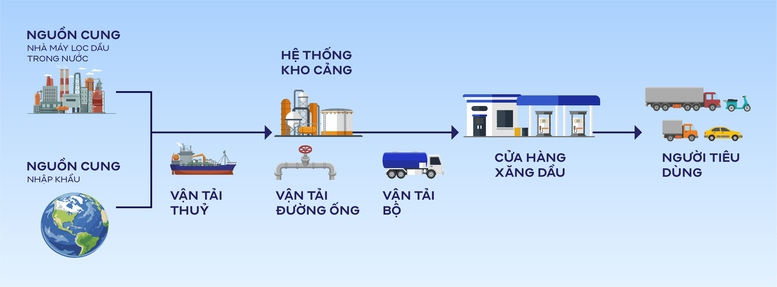
The petroleum supply chain consists of many interconnected links.
This shows that fuel security lies not only in ensuring sufficient supply, but also in the operational capacity of a synchronized logistics system. The fuel supply chain comprises many interconnected links, from receiving supplies from domestic or imported refineries, through the system of ships, receiving ports, main warehouses, storage tanks, pipelines, road and waterway transport, to general distributors and retail outlets.
If one link in the chain is disrupted, the entire system will be under pressure. A delayed shipment can affect restocking plans; limited warehouse capacity makes it difficult for businesses to increase production. attend Storage is necessary during periods of price volatility; while disruptions to interregional transport can lead to local imbalances between regions.
Mr. Ha Dang Son, Chairman of the Center for Energy and Green Growth Research (CEGR), believes that in the context of a volatile global energy market, energy self-sufficiency and diversification of supply sources are crucial requirements for increasing the resilience of the economy. Vietnam has faced supply pressures during periods of high oil prices or when domestic refining and petrochemical operations encountered difficulties. In such situations, the role of logistics systems, storage facilities, and key enterprises becomes particularly important in ensuring an uninterrupted flow of goods.
Currently, major key enterprises play a crucial role in maintaining supply and regulating the market. With their extensive warehouse and port systems, transportation facilities, and distribution networks, these enterprises form the intermediary infrastructure connecting imported goods and supplies from domestic refineries with the consumer market.
Reserve capacity - a strategic buffer for market stability.
Given its nature as an essential commodity and its direct impact from the international market, petroleum is a sector where infrastructure capacity significantly determines the market's resilience.
A country with sufficient supply but lacking storage capacity, regional coordination capabilities, or a comprehensive distribution system can still face the risk of localized disruptions. The major challenge for key businesses lies not only in retail but also in their ability to forecast market trends and maintain the flow of goods under volatile conditions. When world oil prices fall, businesses may be cautious about importing goods to limit the risk of high-priced inventory. Conversely, when oil prices rise, maintaining large inventories also entails pressure on capital, financing costs, insurance, and warehouse operations.
According to energy experts, this is a sector that requires businesses to both ensure business efficiency and maintain a stable supply for the market. This is because the role of logistics infrastructure is clearly demonstrated in three aspects.
Firstly, inventory capacity. Large warehouses help businesses maintain short-term supply, mitigating the impact of disruptions to imports or domestic production.
Secondly, regional coordination capacity. Vietnam has a large geographical area, and consumption demand is uneven across regions. Transporting petroleum products between the North and South, or between consumption centers, requires a synchronized system of transit depots, ships, and transportation.
Thirdly, the distribution network. A wide retail system allows for more efficient control of product flow, reducing reliance on intermediaries during periods of market volatility.
Currently, in the Vietnamese market, the Vietnam National Petroleum Group (Petrolimex) is the largest and most comprehensive petroleum distribution company, possessing a complete infrastructure system including a fleet of petroleum tankers, storage facilities, pipelines, road transport vehicles, and a nationwide retail network. This system enables the company to proactively receive, store, and distribute goods when market fluctuations occur in supply or when supply pressures arise in certain areas.
However, to increase the resilience of the entire market and ensure long-term energy security, the petroleum logistics system cannot rely on just a few enterprises. Along with the Vietnam Oil Corporation, Binh Son Refining and Petrochemical Joint Stock Company, and other key enterprises, continued synchronized investment in storage, logistics, transportation, and distribution capacity will be crucial to diversifying supply sources, increasing coordination capabilities, and reducing the risk of market disruptions during periods of volatility.
The ability to coordinate the supply of petroleum products.
According to many experts, the major risks in the current period are not only oil prices, but also supply chain disruptions, transportation costs, geopolitical instability, and global financial risks. Therefore, energy security in the petroleum sector needs to be viewed from a long-term perspective, not just in terms of supply, but also in terms of infrastructure capacity, reserves, and coordination capabilities.
Ports, pipelines, fleets, transportation systems, and distribution networks, to a certain extent, are not only assets for production and business, but also crucial components of the economy's resilience.
Therefore, the petroleum industry is not just about importing enough supplies or ensuring market circulation. In the context of continued global volatility, the resilience of the economy is increasingly tied to the durability of the energy logistics chain. From a sector-wide perspective, investing in infrastructure, increasing storage capacity, diversifying supply sources, and enhancing coordination capabilities will continue to be crucial foundations for Vietnam to be more proactive in ensuring national energy security, serving the goal of stable and sustainable development.
Source: PT (chinhphu.vn)
Share
BOND GLOBAL LOGISTICS
Hotline: (+84) 787 031 104
E-mail: info@bondlogistics.vn
Address: 4th Floor, No. 274 Da Nang Street, Van My Ward, Ngo Quyen District, Hai Phong City, Vietnam.